TGIF 2025
Hello! You are likely here from my presentation at the Texas Groundwater Invertebrate Forum. Thanks for listening to my talk! Or if not, thanks for perusing my blog!!
One of the things I promoted during my presentation is that there are tons of things to uncover in the genus Parabogidiella, and the “light shining into the darkness” is only very minimal!!
I focused my talk primarily on distributions and diversification. It’s always hard to present this information in a short format like a 10-minute talk, as there is just so much of interest to discuss at the locality/species level, so I focused mainly on broader patterns here. However, all of the information has been distilled into an interactive map that you can pursue on your own time. See below:
From these data, one of the most interesting things, in my opinion, is the three lineages =genera? that were observed. See attached image below. Of particular note was the basal “clade” where we see populations from New Mexico and Bell County, Texas appearing basally-derived in the phylogeny. The biogeographic explanation for this remains elusive, but what is clear is that gaining an understanding of the historical biogeography of both these clades and the genus as a whole could help us understand both the general natural history of hypogean organisms in the region as well as the evolution of groundwater both inside and outside the Edwards-Trinity system.
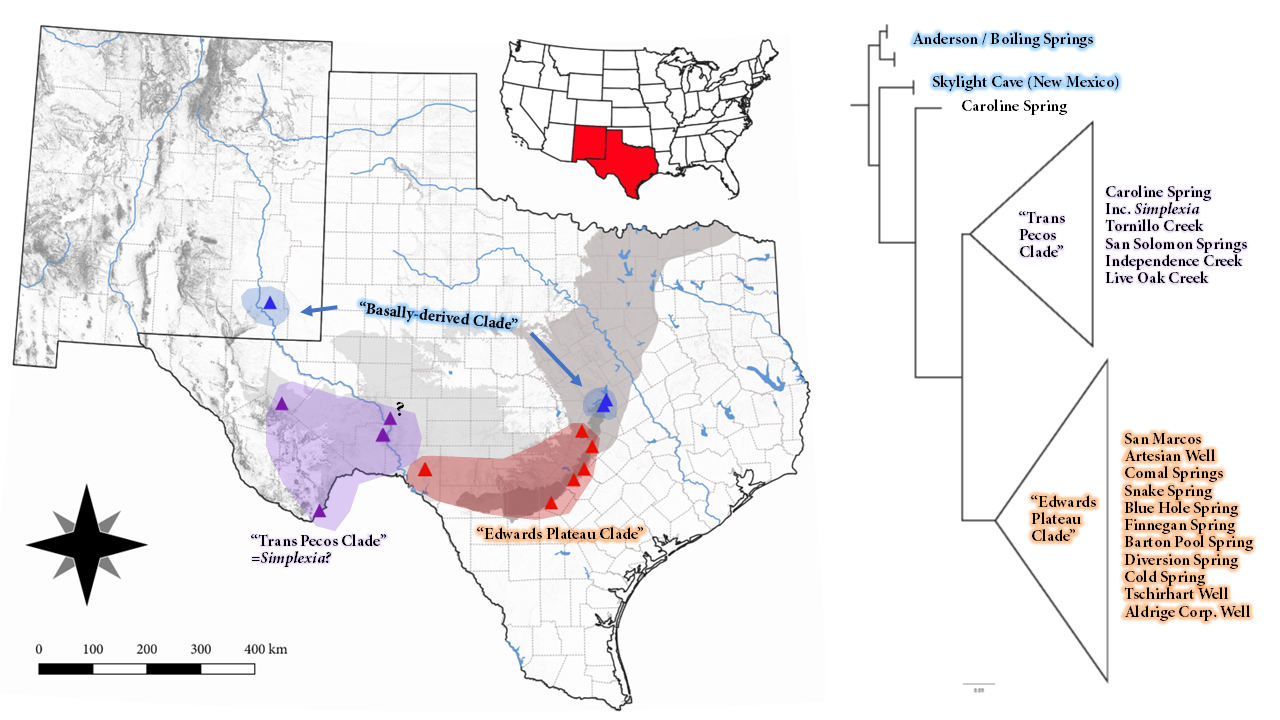
Maximum-likelihood phylogeny is based on a concatenation of three genes (18S, 28S, and 16S)
In addition to the clades observed, we also observed high amounts of species-level diversity. With 15 putative undescribed species identified. See the attached figrue for their phylogeny and distributions. Some sites, like Caroline Spring, and the San Marcos Artesian Well, possessed multiple species!!
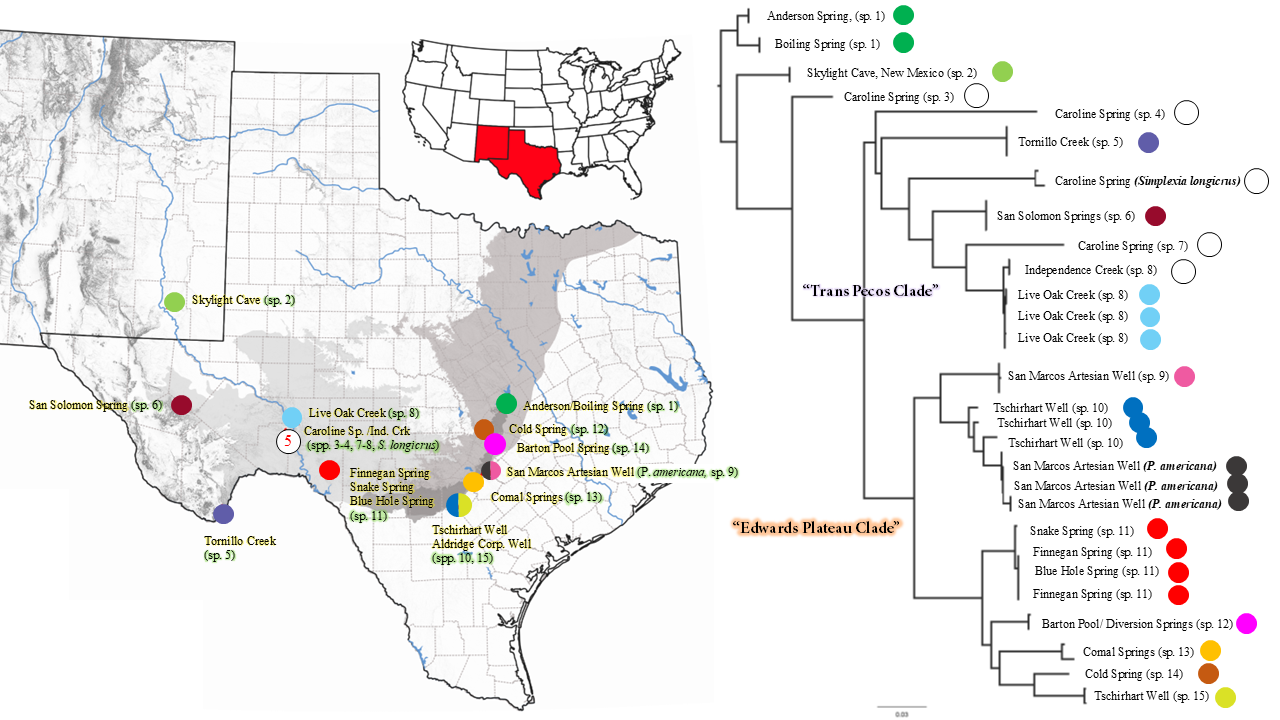
Phylogeny is the same as the previous figure, with clades uncollapsed. Colored circles indicate species.
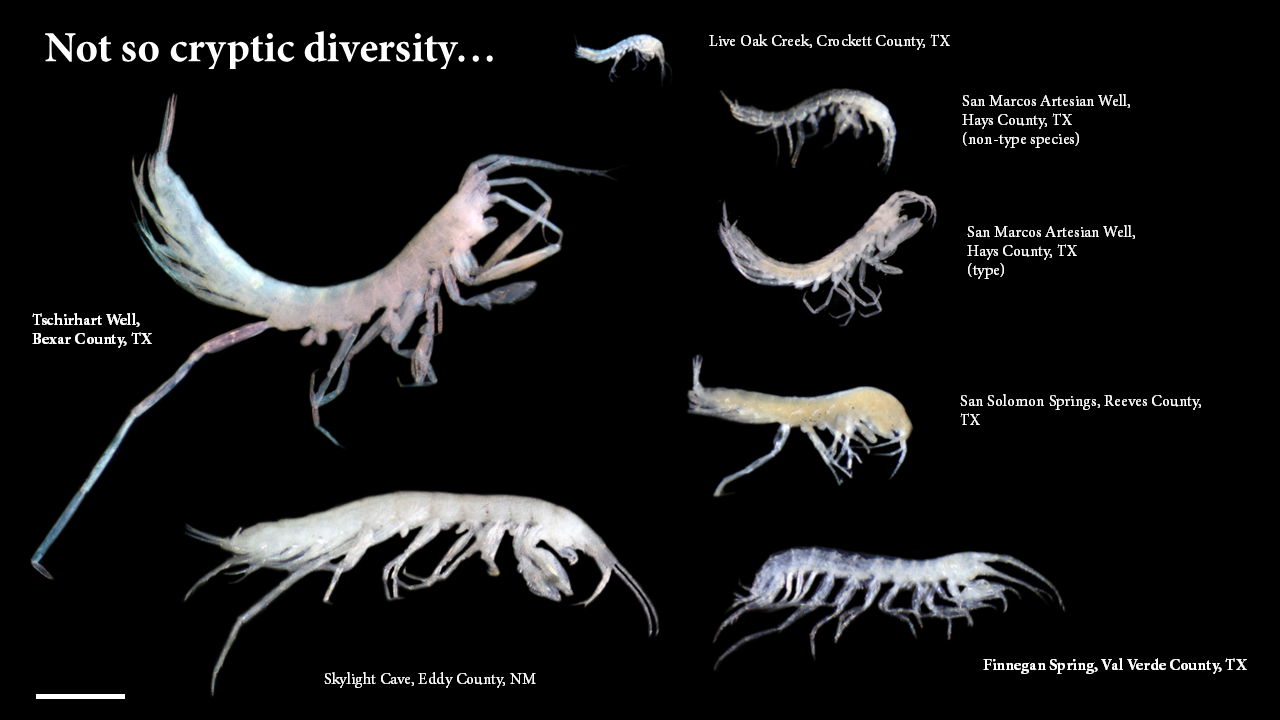
Diversity was not just molecular! The putative species looked different too! Points of morphology like the uropods and gnathopods were highlighted in my talk, but there is also a large amount of variation in size. With individuals ranging from ~0.9-5 mm!! These differences in morphology may be promoted by habitat (hyporheic, deep aquifer, etc…). Further research is needed to elucidate this. Keep an eye out for publications detailing the taxonomy and phylogenetics/biogeography of this interesting group out soon!!